






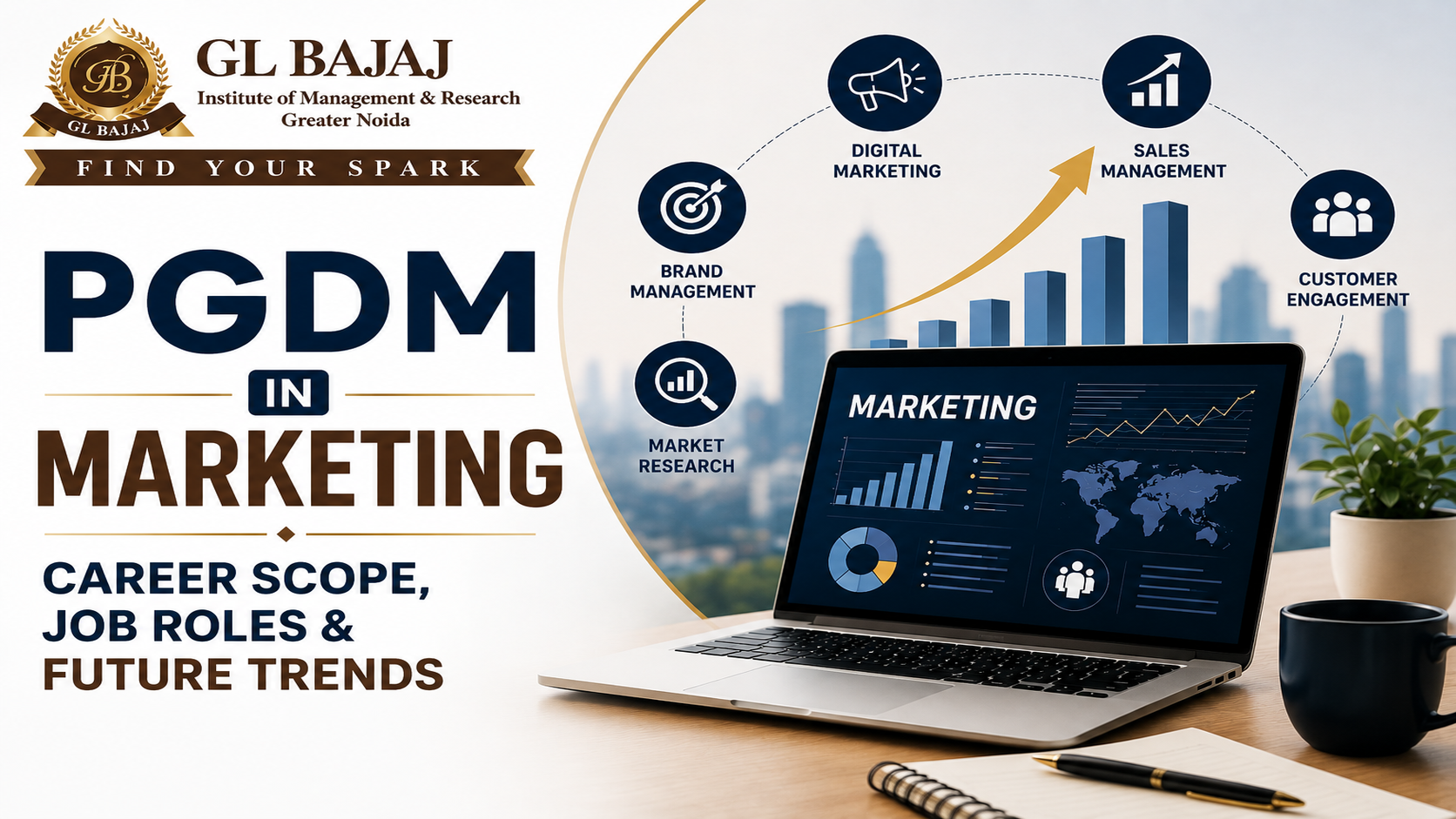
PGDM in Marketing: Career Scope, Job Roles & Future Trends
Posted On: 10 August 2026 | 05:27:pm
What if the biggest marketing opportunity of 2026 is not simply learning how to sell a product, but learning how to understand why people choose it in the first place?
Marketing has changed dramatically in recent times. For businesses, this shift means they can no longer limit marketing to advertising or sales. It has become a data-driven, technology-enabled business function.
For management aspirants, this shift creates an exciting career landscape. A PGDM in Marketing can help build the combination of business knowledge, consumer understanding, analytical ability, and communication skills needed to work in this evolving environment.
What Makes Marketing a Strong Career Choice in 2026?
Modern marketing sits at the intersection of creativity, technology, and business strategy.
According to the World Economic Forum’s Future of Jobs Report 2025, digital access and technological developments are among the major forces reshaping employment through 2030. The report also highlights the growing importance of technology-related skills alongside human capabilities such as creative thinking and analytical thinking.
This matters for marketing professionals because companies increasingly need people who can do more than create campaigns.
In fact, they need professionals who can:
- Understand customer behaviour
- Interpret marketing and sales data
- Build digital campaigns
- Develop brand strategies
- Use AI-enabled marketing tools responsibly
- Measure return on marketing investment
- Coordinate across sales, product, and communication teams
Google’s recent marketing research highlights AI, measurement, and customer understanding as key drivers of marketing performance. In essence, the marketer of the future must possess both a business mindset and digital fluency.
What Does a PGDM in Marketing Teach You?
A well-designed management program should not treat marketing as a collection of theoretical concepts. It should connect classroom learning with how organizations actually make decisions.
At GL Bajaj Institute of Management and Research (GLBIMR), the PGDM curriculum includes marketing management and digital marketing alongside areas such as business analytics, communication, strategic management, and emerging technologies. The institute’s program structure also incorporates live projects, internships, and industry-oriented learning.
This combination is important because marketing decisions rarely happen in isolation.
For example, launching a new product may require you to understand:
- Who the target customer is
- What problem the product solves
- How competitors are positioned
- Which price point makes sense
- Which channels customers use
- How the campaign will be measured
That is where management education becomes valuable, because it teaches the connection between marketing decisions and broader business objectives.
PGDM Marketing Career Scope: What Can You Do After Graduation?
The PGDM marketing career scope extends well beyond traditional advertising roles.
Depending on your interests, skills, and experience, you can explore roles across consumer businesses, technology companies, financial services, consulting, retail, e-commerce, media, and startups.
1. Brand Management
Brand managers work on how a brand is positioned, communicated, and experienced by customers.
Their responsibilities can include campaign planning, market research, competitor analysis, product launches, and coordination with creative and sales teams.
2. Digital Marketing
Digital marketing has become one of the most visible career paths for management graduates.
Roles can involve:
- Search engine marketing
- Search engine optimisation
- Social media marketing
- Content strategy
- Performance marketing
- Email and CRM campaigns
- Marketing automation
The role increasingly requires analytical skills; interpreting campaign performance is as vital as creating engaging content.
3. Sales and Business Development
For the unversed, marketing and sales are closely connected. Companies need professionals who can identify potential customers, build relationships, manage accounts, and convert market opportunities into revenue.
A management graduate may begin as a sales or business development executive and progress towards roles such as territory manager, key account manager, or sales manager.
4. Market Research and Consumer Insights
Professionals in this area analyze surveys, customer feedback, market trends, and behavioral data to help businesses make better decisions.
5. Product Marketing
Product marketing connects the product with its target market.
Professionals may work on positioning, messaging, customer research, product launches, and go-to-market strategies. This role is particularly relevant in technology and digitally driven businesses.
Career Opportunities Are Becoming More Data-Driven
The Marketing career opportunities 2026 landscape is increasingly shaped by data and artificial intelligence.
AI is already influencing how marketers create content, analyze audiences, personalize communication, and optimize campaigns. Google’s marketing research describes AI as increasingly integrated into creativity, media, personalization, measurement, and insights.
However, this does not mean technology replaces marketing professionals. Instead, the value is shifting towards professionals who know how to use technology to make better decisions.
For example, an AI tool may help generate multiple advertising concepts quickly. A marketer still needs to determine whether those concepts are appropriate for the brand, audience, and business objective.
Career Progression After a PGDM in Marketing
A PGDM in Marketing can open doors to diverse career opportunities across industries. While the exact career path depends on your skills, experience, and the organisation you join, professionals generally progress from entry-level roles to strategic leadership positions as they gain expertise and take on greater responsibilities.
A typical career progression may look like this:
| Career Stage | Typical Roles |
| Entry Level | Marketing Executive, Digital Marketing Executive, Sales Executive, Business Development Executive |
| Early Career | Senior Marketing Executive, Brand Executive, Product Marketing Associate, Market Research Analyst |
| Mid-Level Management | Brand Manager, Digital Marketing Manager, Product Manager, Sales Manager |
| Senior Management | Senior Brand Manager, Senior Marketing Manager, Category Manager |
| Leadership Roles | Marketing Head, General Manager – Marketing, Marketing Director |
| Executive Leadership | Chief Marketing Officer (CMO), Vice President – Marketing |
As professionals advance through these roles, their responsibilities expand beyond executing campaigns to leading teams, managing budgets, developing business strategies, analysing market trends, and driving long-term business growth. Continuous learning, industry exposure, and proficiency in emerging areas such as AI, marketing analytics, automation, and customer insights can further accelerate career progression.
Future Trends Every Marketing Student Should Watch
AI-Powered Marketing
AI is moving from experimentation to everyday marketing operations. Today, marketers use AI for customer insights, campaign optimization, content creation, audience segmentation, marketing automation, predictive analytics, and A/B testing, allowing them to make faster, data-driven decisions and deliver more personalised customer experiences.
Search Is Becoming More Conversational
Consumers are increasingly using search, video, and AI-powered experiences to discover information and evaluate products.
Recently, Google reported that Indian shoppers using AI-powered search tools believe these experiences help them make faster and more confident purchasing decisions.
This makes skills such as SEO, content strategy, audience research, and answer-focused content increasingly relevant.
Personalisation at Scale
Customers expect brands to understand their needs. Marketers therefore need to use customer data thoughtfully to deliver more relevant communication without compromising trust or privacy.
Measurement Over Vanity Metrics
Likes and impressions can provide useful signals, but business leaders increasingly want marketers to demonstrate outcomes.
Future marketers will need to understand metrics such as the following:
- Customer acquisition cost
- Conversion rate
- Customer lifetime value
- Return on advertising spend
- Revenue contribution
- Retention and engagement
Omnichannel Customer Journeys
The customer journey is no longer linear. Consumers move between search, social media, video, websites, apps, and physical stores.
Google notes that modern purchase journeys increasingly involve multiple touchpoints, making it harder for marketers to understand where and how decisions are influenced.
This creates demand for marketers who can think across channels rather than treating each platform separately.
How to Prepare for a Marketing Career During Your PGDM
Choosing a specialization is only the beginning. Your career development will also depend on what you do alongside your coursework.
Focus on building a practical portfolio through:
- Live marketing projects
- Internships
- Case competitions
- Consumer research assignments
- Digital campaign simulations
- Excel, Power BI, and analytics skills
- Presentation and communication practice
- Industry interactions
- Relevant certifications and projects
You should also learn to question your own assumptions. If you believe a campaign will work, ask, “What evidence supports that decision?”
That habit of connecting ideas with evidence can differentiate a management graduate from someone who has only studied marketing concepts.
Why Delhi NCR Can Be a Useful Environment for Marketing Aspirants
Location can influence exposure to industries, companies, and professional networks.
A PGDM course in Delhi can give students access to the city’s wider business ecosystem, where sectors such as IT, e-commerce, FMCG, consulting, banking, retail, and startups create diverse business environments.
For students considering GLBIMR, the institute is located in Greater Noida and highlights industry interaction, internships, live projects, and corporate engagement as components of its management education approach.
When evaluating a program, however, students should look beyond location and compare curriculum, faculty expertise, experiential learning, internships, industry exposure, alumni outcomes, and placement support.
Is Marketing a Good Career After PGDM?
Yes, provided you approach it as a business discipline rather than only a creative field.
The PGDM marketing career scope is broad because nearly every organization needs to understand its customers, communicate value, and generate demand.
Your first role may be in sales, digital marketing, brand management, business development, market research, or product marketing. With experience, you can move towards positions involving larger teams, budgets, markets, and strategic decisions.
The important point is that career growth will depend on the skills you build and the problems you learn to solve, not simply the title of your qualification.
Conclusion
Marketing is no longer just about convincing someone to buy. It is about understanding people, identifying opportunities, creating meaningful value, and using technology and data to make smarter business decisions.
That is why the right PGDM course in Delhi can be more than another qualification on your resume. With the right academic environment, practical exposure, and continuous skill development, it can become a foundation for building a career across brand management, digital marketing, sales, consumer insights, product marketing, and business strategy.
The future will belong to marketers who can combine curiosity with evidence, creativity with analytics, and technology with human understanding. If you are ready to develop those capabilities, marketing can offer a career path that continues to evolve and continues to create new possibilities.
Frequently Asked Questions (FAQ)
1. What jobs can I get after a PGDM in marketing?
Common entry-level roles include marketing executive, brand executive, digital marketing specialist, sales executive, business development executive, market research analyst, and product marketing associate.
2. Is digital marketing included in a marketing-focused PGDM?
It can be. At GLBIMR, the published PGDM course structure includes digital marketing along with marketing management and other management subjects.
3. Will AI reduce marketing jobs in the future?
AI is likely to change many marketing tasks rather than simply eliminate the profession. Professionals who can combine AI tools with strategy, creativity, customer understanding, analytical thinking, and ethical judgment are likely to be better positioned for the changing workplace.
4. What skills should a marketing student develop?
Along with marketing fundamentals, students should develop communication, analytical thinking, consumer research, presentation, digital marketing, data interpretation, strategic thinking, and technology skills.
5. How should I choose a PGDM program for a marketing career?
Compare the curriculum, specialization options, practical projects, internships, faculty expertise, industry interaction, placement support, alumni outcomes, and overall learning environment before making a decision.
About The Author