






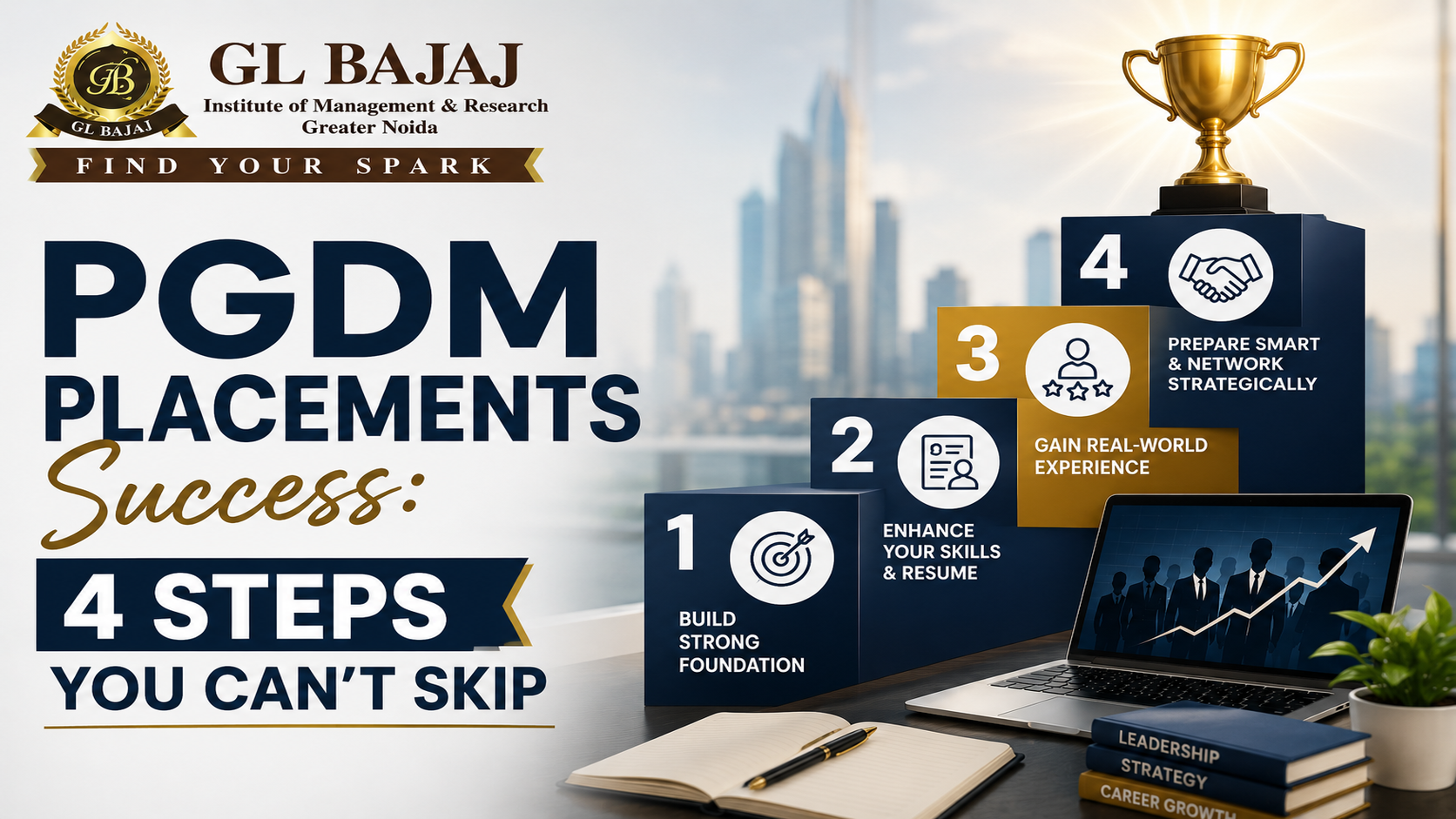
PGDM Placements Success: 4 Steps You Can’t Skip
Posted On: 06 August 2026 | 07:47:pm
Pursuing a PGDM means more than just earning a postgraduate degree. It involves gearing yourself up for a tough professional world. But here’s an important question: Why do some PGDM graduates get multiple job offers while others stay unemployed?
Many students believe placements are determined by aptitude tests, interviews, or the final few months of a PGDM programme. In reality, recruiters assess much more than aptitude tests and interviews. Success usually depends on qualities that go beyond classroom learning. It is the ability to solve problems, communicate effectively, adapt to change, and create value for an organisation. That’s why successful placements are rarely the result of last-minute preparation.
If you’re planning to study at a PGDM College in Delhi NCR, understanding what recruiters truly expect can give you an advantage.
So, before exploring the steps that improve placement outcomes, it’s important to understand what recruiters actually look for in today’s management graduates.
Modern Recruiters Hire Future Leaders, Not Just Graduates
Today’s recruiters are hiring future leaders for their companies, not just degree holders.
Companies seek professionals who can:
- Think critically and make informed decisions
- Communicate ideas with confidence
- Work effectively in diverse teams
- Adapt to changing technologies and business environments
- Solve real business challenges
This shift has transformed management education. In line with the emphasis on industry-oriented learning promoted by the All India Council for Technical Education (AICTE), leading institutions are integrating live projects, internships, case studies, simulations, industry exposure, and professional certifications into their curriculum to prepare students for the workplace.
Choosing a PGDM College in Delhi NCR that provides strong industry exposure and career development opportunities can make a meaningful difference in a student’s professional journey.
So, how can students turn these expectations into placement success? It begins with four practical steps that can be followed from the very first semester.
4 Steps You Can’t Skip for PGDM Placement Success
Step 1: Start Building Employability Skills from Day One
One of the biggest mistakes students make is waiting until placement season to improve their skills. Academic scores alone no longer impress recruiters. Today’s employers look for candidates who are workplace-ready and capable of contributing from day one.
According to the World Economic Forum’s Future of Jobs Report, analytical thinking, problem-solving, communication, leadership, and adaptability are among the most in-demand skills in today’s workplace. Developing these competencies early can significantly improve your placement readiness.
To build a strong placement profile, students should focus on developing the following skills:
- Business communication
- Analytical thinking
- Problem-solving ability
- Data interpretation
- Presentation skills
- Leadership qualities
- Digital literacy
- Team collaboration
Students can strengthen these skills by actively participating in classroom discussions, case study competitions, management fests, business simulations, industry-led projects, and group presentations. Additionally, pursuing professional certifications in emerging domains such as data analytics, digital marketing, financial modelling, or project management can further enhance employability.
These are among the most valuable PGDM placement tips because recruiters consistently evaluate candidates on their ability to apply knowledge, solve business problems, and collaborate effectively, not just on their academic performance.
Step 2: Treat Every Internship Like a Job Interview
In today’s job market, internships are not just academic requirements; they play a crucial role in career preparation.
They provide opportunities to:
- Understand corporate culture
- Apply classroom concepts
- Build professional relationships
- Gain hands-on experience
- Strengthen your resume
Many organisations also use internships to identify future full-time employees through pre-placement offers (PPOs).
During your internship:
- Be punctual and dependable.
- Ask thoughtful questions.
- Volunteer for responsibilities.
- Meet or exceed deadlines.
- Request constructive feedback.
Students who approach internships with professionalism often develop stronger confidence during placement interviews.
Step 3: Create a Professional Brand Before Recruiters Find You
- Strong skills and internship experience are valuable, but recruiters also evaluate how effectively you present yourself. Building a professional brand helps you stand out and creates a positive first impression even before the interview begins.
- Start by creating a well-structured resume that highlights your academic achievements, internships, projects, certifications, and extracurricular activities.
Equally important is maintaining an updated LinkedIn profile that reflects your skills, accomplishments, and career aspirations. Recruiters often review candidates’ online profiles to understand their professional interests and engagement.
- Students can further strengthen their professional presence by developing a digital portfolio that showcases case studies, presentations, research work, business competitions, or live projects completed during the PGDM programme.
Sharing industry insights, participating in professional discussions, and connecting with alumni, faculty members, and industry experts on LinkedIn also helps build a credible personal brand and expand professional networks.
- A strong professional profile not only increases your visibility among recruiters but also demonstrates your commitment to continuous learning and career development.
Step 4: Stay Updated and Prepare Consistently
- Placement preparation is an ongoing process rather than a last-minute activity. Staying informed about the latest developments in business and the economy enables students to perform confidently during aptitude tests, group discussions, and personal interviews.
- Develop the habit of reading business newspapers. Regularly follow industry reports, quarterly company earnings, AI and technology trends, government policy updates, and sector-specific developments relevant to your area of interest.
This knowledge not only strengthens your business awareness but also helps you provide informed and relevant responses during interviews.
- Along with staying updated, practise aptitude tests, participate in mock interviews, improve your communication skills, and seek regular feedback from mentors and faculty members. Consistent preparation builds confidence and ensures that you are ready to seize placement opportunities whenever they arise.
- Students who remain informed, adaptable, and well-prepared are better equipped to meet changing industry expectations and make a lasting impression on recruiters.
Common Mistakes Students Should Avoid
Even competent students occasionally miss out on opportunities because of their own mistakes.
Make sure you don’t fall into these pitfalls:
- Waiting until the final semester to prepare
- Ignoring communication skills
- Skipping internships or projects
- Building a generic resume
- Neglecting networking opportunities
- Avoiding mock interviews
- Depending only on academic marks
Recruiters assess much more than CGPA. They evaluate your communication skills, problem-solving ability, professionalism, and overall placement readiness.
How the Right College Supports Placement Success
Ultimately, successful placements are the result of consistent effort supported by the right academic environment.
An industry-oriented management institute typically provides:
- Industry-aligned curriculum
- Experienced faculty
- Corporate mentoring
- Internship opportunities
- Soft-skill development
- Placement readiness programmes
- Personality development sessions
- Alumni networking
- Live business projects
When choosing a PGDM college in Delhi NCR, evaluate factors such as faculty expertise, industry exposure, recruiter engagement, internship opportunities, career support, and experiential learning instead of relying solely on placement statistics.
Institutions that consistently collaborate with industry create an ecosystem where students develop both technical knowledge and employability skills. This improves long-term career outcomes.
The Placement Journey Is a Continuous Process
Placements are the result of numerous small efforts made during your PGDM journey.
Every experience contributes to placement readiness:
- Every presentation builds confidence.
- Every internship builds experience.
- Every industry interaction builds perspective.
- Every project strengthens your professional profile.
When these experiences come together, they create a candidate who is prepared not just to secure a job, but to build a meaningful career.
Taken together, every presentation, internship, project, and industry interaction contributes to your overall placement readiness.
Conclusion
A successful placement is not achieved overnight; it is earned through continuous learning, practical exposure, professional discipline, and a willingness to improve every day.
By developing industry-relevant skills, making the most of internships, strengthening your professional profile, and preparing consistently, you significantly improve your chances of securing rewarding career opportunities.
If you’re planning your management education, GL Bajaj Institute of Management and Research combines academic excellence with strong industry engagement. It also provides the right platform to transform your potential into professional success.
Frequently Asked Questions (FAQs)
1. How many internships should a PGDM student complete?
Ans: At least one mandatory internship is common, but additional live projects and internships can strengthen your profile.
2. What do recruiters expect from fresh PGDM graduates?
Ans: Recruiters look for problem-solving ability, communication skills, adaptability, teamwork, and industry awareness alongside academic knowledge.
3. Do certifications improve placement opportunities?
Ans: Relevant certifications can strengthen your resume by demonstrating practical skills and continuous learning.
4. How important is networking during a PGDM programme?
Ans: Networking helps students connect with industry professionals, alumni, and recruiters, creating valuable career opportunities.
5. How can students evaluate a PGDM college beyond placement statistics?
Ans: Consider the curriculum, faculty, industry exposure, internships, corporate collaborations, alumni network, and career support services.
About The Author